
Identification and serialisation for the pharmaceutical supply chain
GS1 standards enable the unique identification of medicines, organisations and locations, and support serialisation, verification and traceability processes throughout the pharmaceutical supply chain.
From manufacturer to pharmacy and hospital
From production and distribution to the pharmacy or hospital, GS1 standards enable consistent identification of medicines and connect the information needed at every stage.
Every product and location, identified without ambiguity
Standardised identification is the foundation of automated processes in the pharmaceutical industry. GS1 standards let systems from different organisations recognise the same products, locations and logistic units.
Product identification
The Global Trade Item Number uniquely identifies the pharmaceutical product and allows it to be recognised across information systems.
Identification of organisations and locations
The Global Location Number uniquely identifies companies and physical or functional locations involved in the pharmaceutical chain.
Identification of logistic units
The Serial Shipping Container Code enables the unique identification of pallets and other logistic units during distribution.
Automatic data capture
The 2D symbol makes it possible to represent, in a small space, the product identifier and the variable data required by the application, such as the serial number, batch or expiry date.
Every medicine can be identified and verified individually
Serialisation associates each unit of medicine with a unique identity, used to verify its authenticity before it is dispensed to the patient.
Through GS1 DataMatrix, the necessary information — the product identifier, serial number, batch and expiry date — can be captured automatically with a single scan.
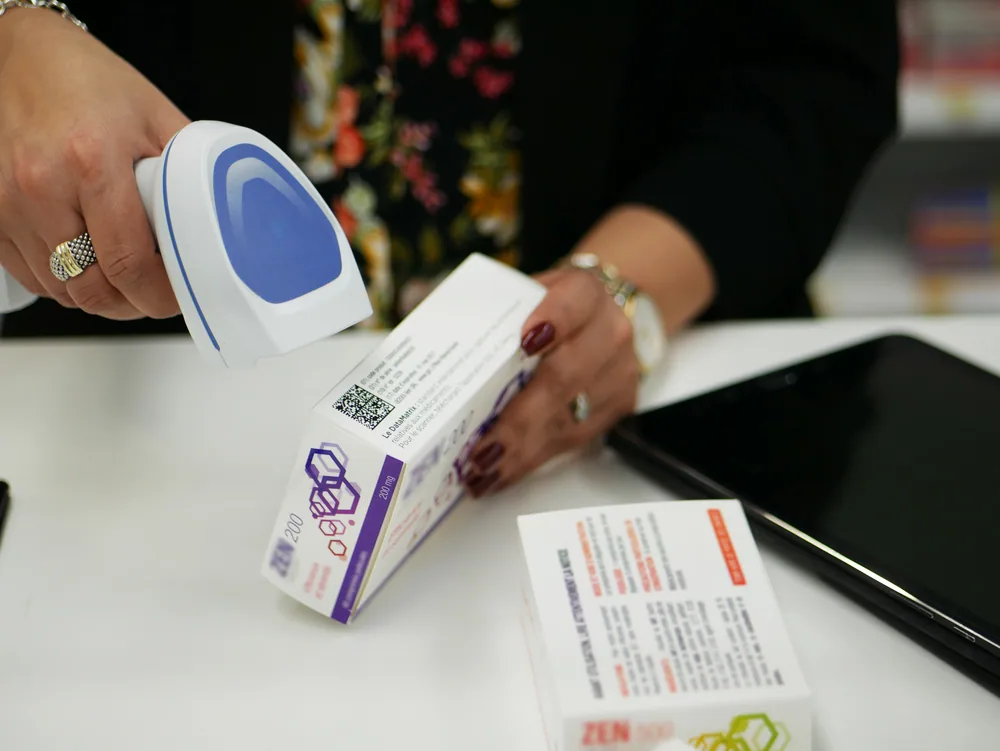
What product it is
Which individual unit it is
Which batch it comes from
Until when it can be used
Standardised identification connects the physical product with the information needed for verification and traceability processes.
Continuous identification, including at the point of verification
Within the National Medicines Verification System (SNVM), the parties involved in distributing and dispensing medicines carry out verification and decommissioning processes in line with applicable requirements.
For these processes to work correctly, it is not enough to identify the medicine alone. The location where verification takes place must also be identified without ambiguity.
A more connected pharmaceutical chain
Unambiguous identification
Products and locations are identified through standardised identifiers, recognised by the systems of every participant in the chain.
Automatic data capture
Scanning the GS1 DataMatrix reduces reliance on manual data entry.
Traceability
Standardised identifiers support tracking products and logistic units throughout distribution.
Batch and expiry management
The relevant data can be captured automatically and used in operational processes.
Interoperability
A common language makes it easier to exchange information between manufacturers, distributors, pharmacies, hospitals and information systems.
Supporting verification processes
Identifying products and locations helps verification and decommissioning processes to function correctly.
Solutions for the pharmaceutical industry
Pharma SNVM Identification — MEDALOC
Manage the GLN identifiers of the functional locations used in the processes associated with the National Medicines Verification System.
Discover MEDALOCPrice files — CANAMED
The platform used by the pharmaceutical industry to request and validate medicine prices: portfolio management, price calculation, generating and electronically signing the price file, and tracking its status.
Discover CANAMEDWhere do you start?
Identify your products
Assign the GS1 identifiers required for your pharmaceutical products.
Prepare your data
Determine the data needed for identification, serialisation and the processes that apply to your products.
Implement marking
Use the appropriate GS1 symbols to represent and automatically capture the data.
Identify locations
Assign GLNs to the locations that need to be identified in the relevant processes.
Integrate your systems
Connect identification and data with the processes and information systems used by your organisation and its partners.
What you need to know about identification and serialisation in Pharma
Answers to the most common questions about GS1 standards applied in the pharmaceutical industry.